Most dog escapes don't start with a cinematic jailbreak — they start with a loose fence board, a gate latch the wind knocks open, or a gap under the deck nobody noticed. If your dog has ever surprised you in the front yard, you already know the panic. The good news: a few weekend fixes go a long way. Here's how to escape-proof your backyard for dogs in 2026, room by room — or rather, fence line by fence line.
Walk the Perimeter Like Your Dog Would
Before you buy anything, do a slow lap of your fence on a dry day and look at it from your dog's eye level. You're looking for three things: gaps, gain points, and weak spots.
Gaps are the obvious ones — missing pickets, soft soil where small dogs can dig under, drainage holes a determined terrier could squeeze through. A 4-inch opening is enough for many puppies and small breeds. Stuff temporary gaps with treated lumber or galvanized hardware cloth buried 6–12 inches deep.
Gain points are anything your dog could use as a launchpad: AC units, woodpiles, garden benches, recycling bins, kids' play structures, even a thick layer of mulch right against the fence. Move them at least 3 feet away from the perimeter.
Weak spots are the boards that wiggle, the latch that's a little stiff, the post that leans after the last storm. Fix these now — they only get worse, and your dog notices long before you do.
Upgrade Your Fence Without Replacing It
You don't need to rebuild a whole fence to escape-proof your backyard. A few targeted upgrades stop almost every common escape.
For diggers, run a "dig guard": galvanized welded wire (1×2 inch grid) attached to the bottom of the fence and bent outward in an L-shape, then buried under 2–4 inches of soil. Dogs paw down, hit the wire, and give up.
For climbers and jumpers, add coyote rollers or a 45-degree inward "lean-in" extension along the top of the fence. Coyote rollers were originally designed to keep predators out — they work just as well to keep athletic dogs in. For tall jumpers, raise the visible fence height by 12–18 inches with lattice or trellis. A solid (not see-through) fence reduces the urge to jump because there's nothing visible to chase.
If you've got chain link, run a privacy slat or windscreen across it. Most dogs jump because they spot a squirrel, a delivery driver, or another dog — take away the visual trigger and the behavior often fades on its own.
Lock Down Gates, the #1 Escape Route
Survey any group of dog owners and the same story comes up: "The gate was latched, but…" Gates are the weak link in almost every backyard. Three quick fixes:
- Install a self-closing hinge so the gate can never be left ajar by a kid, a delivery person, or yourself when your hands are full of groceries.
- Add a second latch low on the gate — many dogs learn to pop a single top latch with their nose. Two latches at different heights defeat almost all of them.
- Use a carabiner or padlock as a third layer, especially if landscapers, meter readers, or pool techs come through. They will leave gates open. Plan for it.
Walk the gate test once a month: open it, let it swing, and see if it self-closes and self-latches every time. If not, fix the spring or the alignment immediately.
Plan for the One Time It Doesn't Work
Even a perfect fence can fail. A storm knocks down a section. A guest props the gate open with a chair. Your dog discovers a new gap behind the shed. That's why every escape-proofing plan needs a "what if they get out anyway" layer — and that layer is identification.
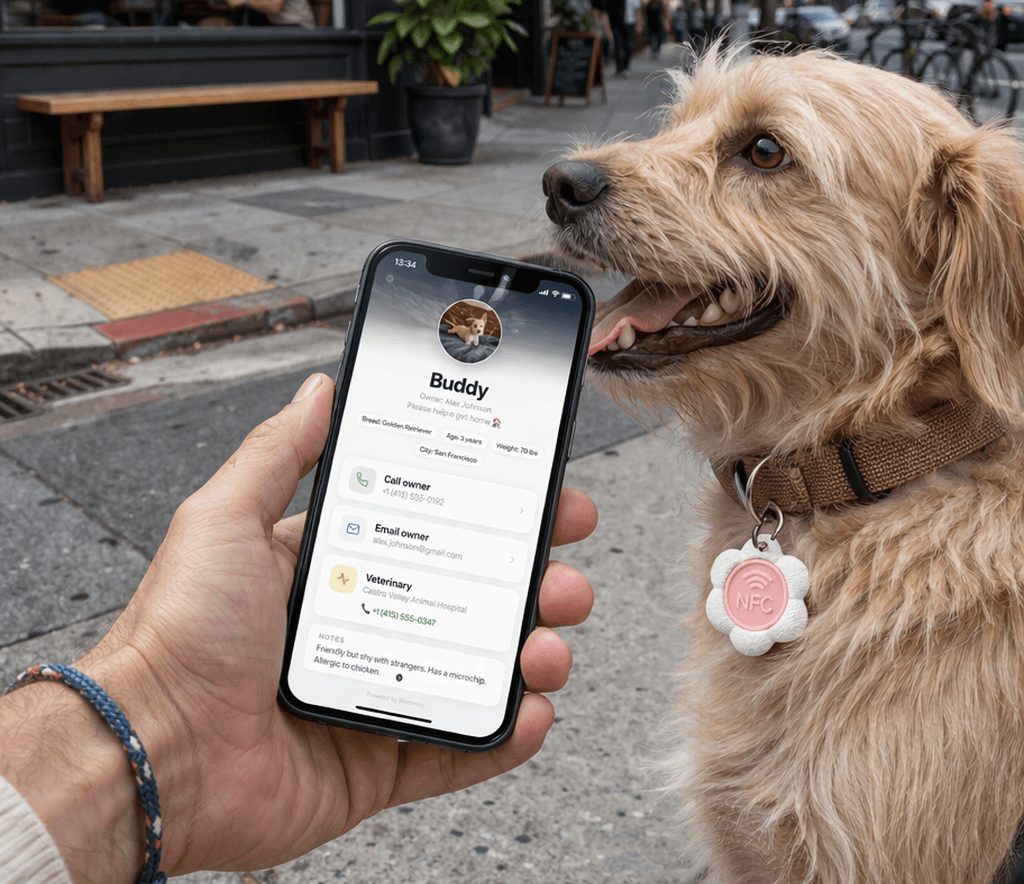
A modern smart ID tag is the single highest-leverage thing you can add. The Bloomtag NFC pet tag lets anyone who finds your dog tap it with any smartphone — no app, no setup, no subscription — and instantly see your contact details, your dog's name, medical notes, and a "currently lost" alert if you flip it on. It's a one-time $24.99 purchase and it works alongside (not instead of) the microchip your vet implanted. For more on combining these, see our guide on microchip vs dog ID tag.
Pair the tag with a clearly visible collar in a bright color, and make sure your phone number on file is the one you actually answer.
Train the Behavior, Not Just the Fence
Hardware buys you a margin of safety; training closes the gap. A few habits worth building:
- Teach a rock-solid recall with high-value treats, practiced daily in the yard before you ever need it in an emergency.
- Never open the back door without a sit-and-wait — door-darting accounts for a huge share of escapes that have nothing to do with the fence.
- Spay or neuter if you haven't; intact dogs roam significantly more.
- Burn off energy daily. A tired dog isn't plotting a breakout. A bored dog with no walk all day absolutely is.
Together, these four habits are cheaper than any fence upgrade and prevent more escapes than most people realize.
Final Thoughts
Escape-proofing your backyard isn't one big project — it's a perimeter walk, a gate fix, a dig guard, a smart ID tag, and a five-minute door-manners drill. Do those this weekend and your dog's risk drops dramatically.
Want the safety net that works the moment everything else fails? Grab a Bloomtag smart NFC pet tag — $24.99, free worldwide shipping, no subscription, ever. The day a stranger taps your dog's tag and your phone rings, you'll be very glad it's there.