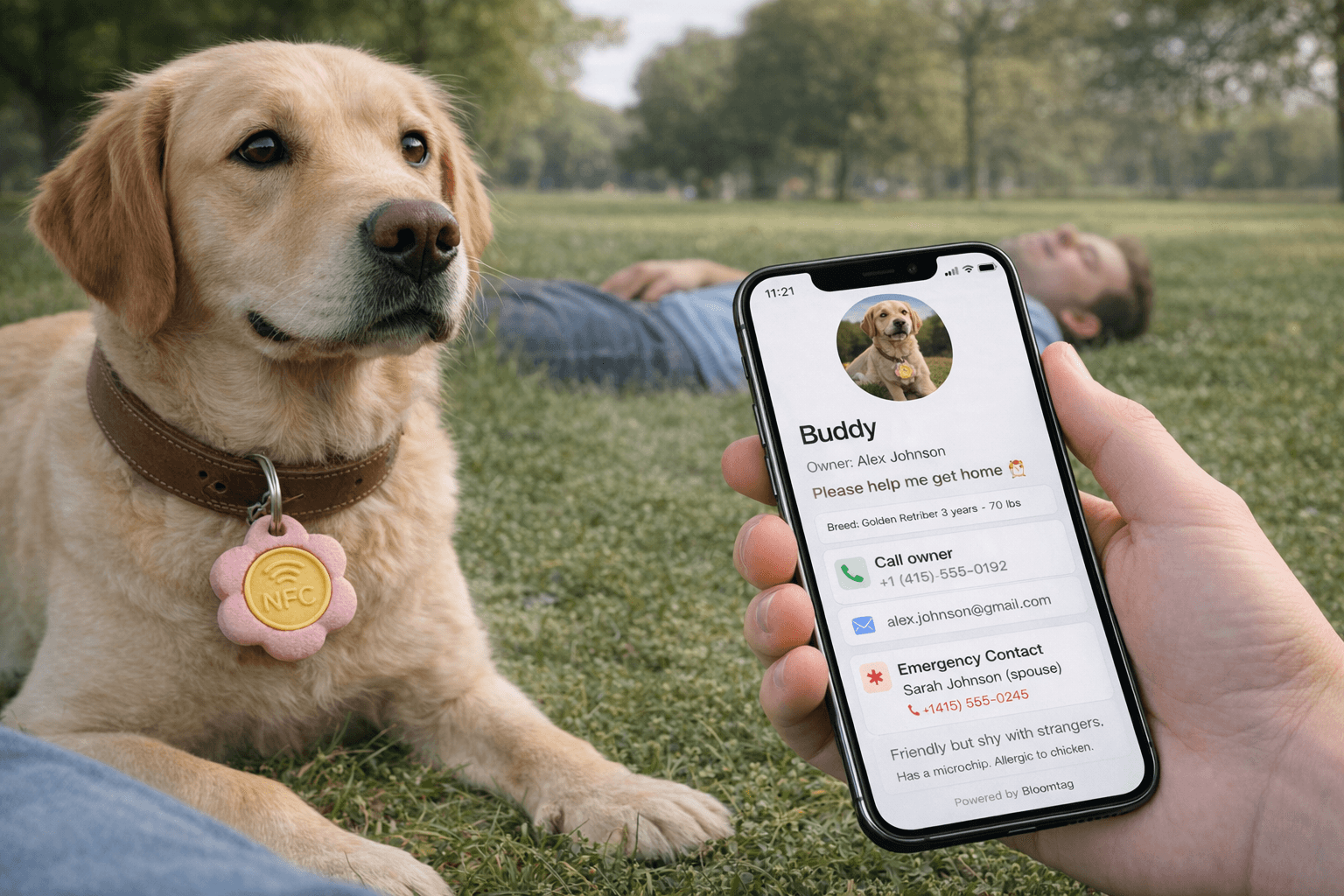
If your dog ever slips out the door, two things decide how quickly they come home: a microchip and a dog ID tag. Most owners assume one is enough — but that's exactly the assumption that keeps dogs in shelters for days. The microchip vs dog ID tag debate isn't really a debate at all. They solve different problems, and in 2026 the smartest owners use both.
Here's a clear, no-fluff guide to what each actually does, where they fall short, and how to build a recovery plan that actually works when it matters most.
What a Microchip Actually Does
A microchip is a tiny RFID capsule, about the size of a grain of rice, implanted between your dog's shoulder blades by a vet. It contains a unique ID number that shows up when a vet or shelter scans it with a special reader.
The chip itself doesn't store your phone number or address. Instead, it points to a record in a pet recovery database — which only helps if that record is kept up to date. A 2024 AVMA study found that nearly 40% of microchipped dogs brought into shelters had outdated or missing owner contact info.
So a microchip is a permanent, tamper-proof fallback. But it has real limitations:
- It only works if someone brings your dog to a vet or shelter with a scanner
- It won't help a neighbor standing in front of your lost dog on the sidewalk
- It relies on you keeping the registry record current
- It gives you no way to be reached instantly
A microchip is insurance. It's not a quick-return system.
What a Dog ID Tag Actually Does
A dog ID tag is your first line of recovery — the thing the average person can read the moment they find your dog. Whoever picks up your pup doesn't need a scanner, an app, or a vet visit. They just look at the tag and get in touch.
That's why every vet and shelter in the country recommends a visible ID tag, even for chipped dogs. According to ASPCA data, dogs wearing visible ID are returned to their owners roughly 3x faster than dogs relying on a microchip alone.
Traditional engraved tags cover the basics, but they have their own weaknesses — worn-out engraving, limited space for info, and no way to update details without buying a new tag. That's where modern smart tags come in.
Why a Modern NFC Tag Beats a Basic Engraved One
A smart NFC dog tag like Bloomtag closes the gaps traditional tags leave open. When someone taps it with any smartphone, your full contact page opens instantly — no app, no account, nothing to download. You can update your number, address, medical notes, or a vet contact anytime without replacing the tag.
Compared to an engraved tag, an NFC tag:
- Holds unlimited info (phone, backup contact, meds, allergies, microchip ID)
- Updates instantly when you move or change numbers
- Never wears off from scratching, mud, or water
- Works with any modern smartphone out of the box
It's the difference between a static sticker and a living profile for your dog.
Microchip vs Dog ID Tag: The Honest Comparison
Here's the side-by-side that actually matters:
Microchip
- Permanent, can't fall off
- Requires a scanner (vet/shelter only)
- Slow recovery path
- Easy to forget to update registry
Dog ID Tag (traditional engraved)
- Instantly readable by anyone
- Fast recovery path
- Limited info space
- Engraving fades; info goes stale
Smart NFC Dog Tag
- Instantly readable by any smartphone
- Fast recovery path
- Unlimited, editable info
- Waterproof and durable
The winner isn't one or the other. It's a microchip for the worst case (your dog ends up at a shelter with no tag) plus a smart ID tag for the most likely case (a neighbor finds them two blocks over).
What Every Dog Should Wear in 2026
A complete safety setup looks like this:
- A registered microchip with current contact info in the database
- A durable, visible ID tag on the collar at all times
- Updated vaccination and rabies tags where required by law
- A photo of your dog saved somewhere you can grab fast
If you want to skip the worn-out engraving problem entirely, a smart NFC tag is the most future-proof option. You get the readability of a physical tag with the flexibility of a digital profile — and you'll never have to re-engrave a tag again.
The Bottom Line
Microchips and ID tags aren't competitors. They're teammates. A microchip protects your dog in the worst scenarios; a visible ID tag gets them home in the everyday ones. Relying on only one is like locking your front door but leaving the windows open.
If your dog's current tag is scratched, fading, or missing details, now is the time to upgrade. Bloomtag is a flower-shaped NFC tag that any smartphone can read, updates instantly when your info changes, and ships free worldwide for a one-time $24.99 — no app, no subscription, ever. Pair it with a current microchip registration and you've built the safest recovery setup a 2026 dog owner can wear.