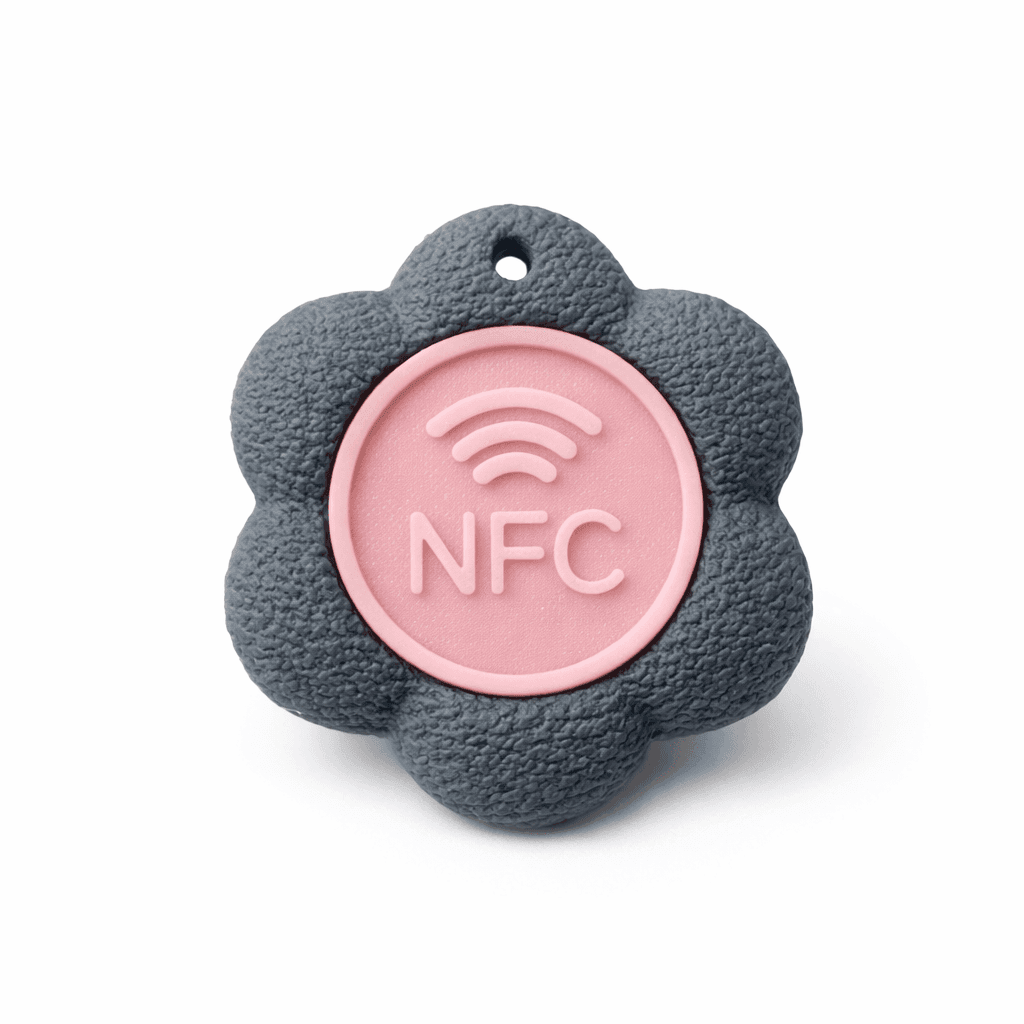
If you're shopping for a smart dog tag, you've probably noticed two competing technologies: QR code dog tags and NFC dog tags. They look similar, they both promise to bring your lost dog home faster than a basic engraved disc, and they're priced in roughly the same range. So which one actually works better in 2026?
Short answer: NFC is faster, more reliable in the moment, and better for privacy. QR codes have one real advantage — they work on any phone with a camera. Below, we break down the real-world tradeoffs so you can pick the right tag for your dog.
How QR code dog tags work
A QR code dog tag has a printed (or laser-etched) QR pattern. When a finder scans it with their phone camera, it opens a web page with your contact details. Simple and familiar — most people have scanned a QR code on a menu or poster.
The catch: the finder has to open their camera app, frame the code well enough to scan, and have decent lighting. On a wiggling dog, in the rain, at dusk, on a scratched-up tag — that's not always easy. If the printed code wears down (and printed codes do wear down on collars), it can stop scanning entirely.
How NFC dog tags work
An NFC dog tag contains a tiny chip embedded in the tag. The finder just taps their phone against the tag — no camera, no app, no aiming. The owner's contact page opens instantly. Modern iPhones (XS and newer) and almost every Android phone made in the last decade can read NFC out of the box.
Because the data is on a chip, not a printed pattern, it doesn't fade, scratch off, or stop working when the tag gets muddy. NFC also works in the dark and in the rain, which matters when your dog has been gone for hours.
QR code vs NFC dog tags: head-to-head
Here's how the two compare on the things that actually matter when a stranger finds your dog:
Speed to contact you. NFC wins. A tap takes about 1 second. Lining up a QR scan on a moving dog typically takes 5–15 seconds, sometimes longer if the finder isn't tech-savvy.
Reliability over time. NFC wins. Printed QR codes degrade with abrasion, sunlight, mud, and chewing. NFC chips are sealed inside the tag housing and keep working for years.
Works in the dark or rain. NFC wins. Cameras need light and a clean surface. NFC just needs proximity.
Phone compatibility. QR has a slight edge here — every smartphone with a camera can scan a code. NFC needs an NFC-capable phone, but in 2026 that's effectively every phone less than 10 years old.
Privacy. NFC wins. A QR code can be photographed and the URL extracted without you knowing. With NFC, the finder has to physically be next to your dog to access anything.
No app needed. Both tie. Modern QR scanning is built into the camera, and modern NFC is built into the OS. Neither tag should require a download.
When a QR tag might still make sense
If your dog's finder is most likely to be an older smartphone user, or someone in a region where NFC adoption is lower, a QR code is a reasonable fallback. Some hybrid tags include both — but those tend to be bulkier and more expensive, and split your "tap target," which can confuse finders.
For most owners in North America, Europe, and Australia, NFC is the better default in 2026. Phones support it natively, and finders don't need any instructions — they just hold their phone close to the flower-shaped tag and the contact screen pops up.
What to look for in any smart dog tag
Whichever technology you choose, the basics still matter:
A durable, waterproof housing that survives swimming, mud, and a year of sniffing the world. A clear, visible cue on the tag itself — printed text or an icon that tells the finder "tap me" or "scan me" — because no technology helps if the finder doesn't know it's there. An owner page you can update without ordering a new tag, so when you move or change phone numbers your tag isn't suddenly out of date. And a one-time price with no recurring fees — you shouldn't need a subscription to keep your dog's contact info live.
Bloomtag is built around exactly that brief: a flower-shaped NFC tag in five colors (Blossom, Buttercup, Cornflower, Sakura, and Storm), $24.99 one-time, no app, no subscription, free worldwide shipping. Tap any phone and the owner's contact page opens instantly.
The bottom line
QR code dog tags work, but NFC dog tags work better for the moment that matters — when a stranger has your dog, it's getting dark, and they need to reach you in seconds, not minutes. The fewer steps between "found a dog" and "called the owner," the more likely your dog comes home tonight instead of ending up at a shelter.
Ready to upgrade from a printed code or a basic engraved tag? Pick your Bloomtag color — your dog's safety net is one tap away.