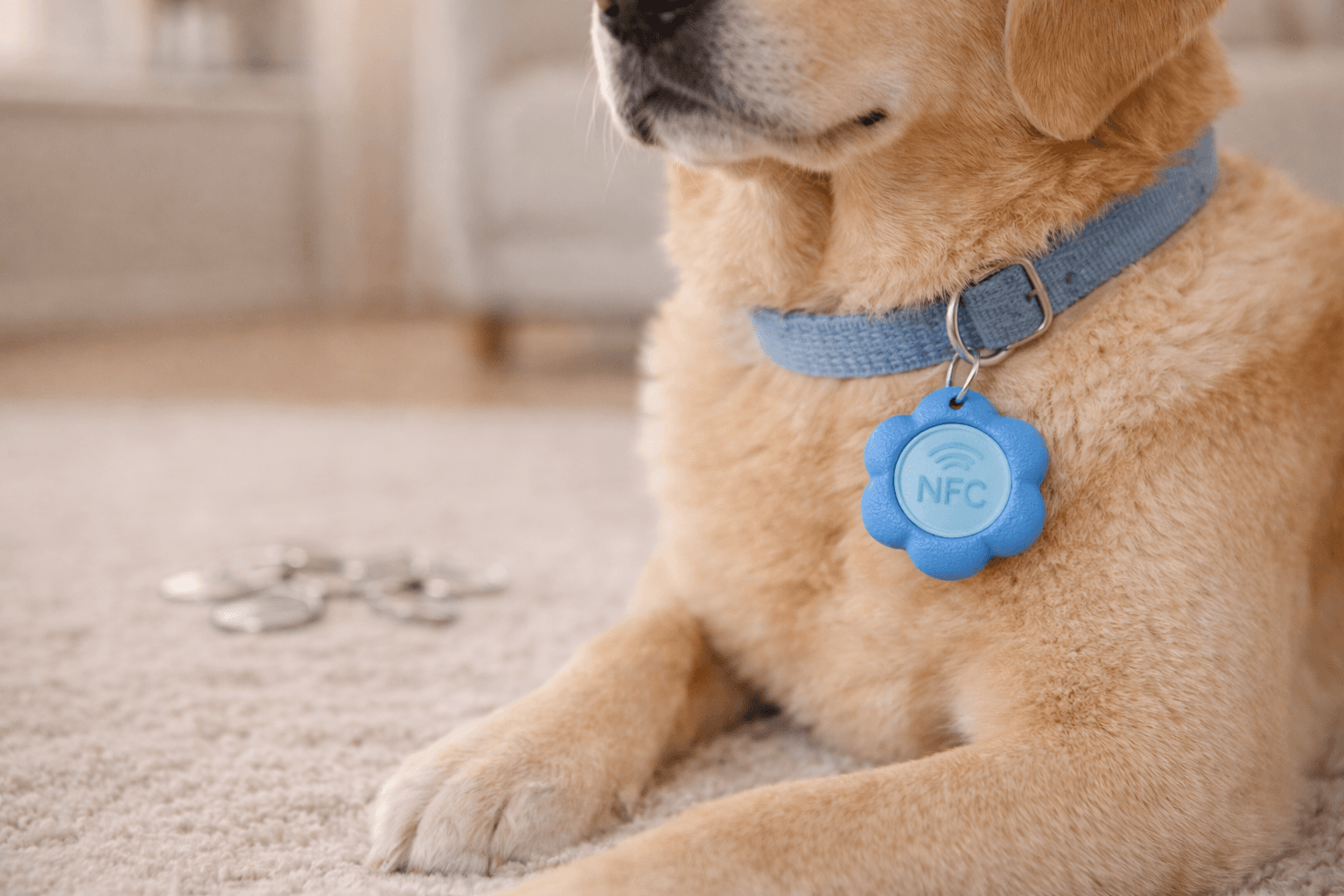
If your dog is an escape artist or a wanderer, you've probably wondered whether to clip on a GPS tracker, an NFC tag, or both. They sound similar — they're not. A dog GPS tracker shows you a moving dot on a map. An NFC tag is what a stranger taps to call you the moment your dog turns up two streets over. Each solves a different half of the lost-dog problem, and picking the right tool (or pair) saves you stress and money.
Here's a clear, no-fluff comparison for 2026.
Dog GPS Tracker vs NFC Tag: The Core Difference
A dog GPS tracker is an active device. It connects to satellites and a cellular network to broadcast your dog's live location to an app. Think Fi, Whistle, Tractive, or Garmin Astro. They're powerful when your dog runs and you need to chase the signal yourself.
An NFC tag is a passive ID tag. There's no battery, no signal, and no subscription. When someone finds your dog, they tap the tag with any NFC smartphone and your contact page opens — they call, you reunite. No app, no setup on their end.
In a real lost-dog scenario, both can matter. The GPS tracker helps you find a dog who's still moving. The NFC tag helps a stranger reach you the moment your dog stops moving and gets picked up.
Cost: Upfront and Ongoing
This is where the gap is biggest.
GPS trackers usually cost $50–$150 upfront, plus a monthly or annual subscription for the cellular connection. Most plans run $5–$15/month, which adds up to $60–$180 a year — every year — for the tracker to stay live. Skip the subscription and the device becomes a paperweight.
NFC tags are a one-time purchase. Bloomtag, for example, is $24.99 with no subscription, ever. You update your contact details from your phone whenever you move or change your number, and the tag keeps working for the life of the dog.
Over five years, a typical GPS tracker setup costs $350–$900. An NFC tag costs $24.99. That's not a knock on GPS — it's just a different category of product.
Battery, Reliability, and Daily Wear
GPS trackers need charging every 1–7 days depending on the model and how often it pings. Forget to charge it the night your dog slips out, and it's not helping anyone. They're also bulkier — usually a separate puck clipped to the collar — which can be uncomfortable for small or medium dogs.
NFC tags have no battery. Nothing to charge, nothing to fail. A good NFC tag is sealed, waterproof, and small enough to live on the collar 24/7. Bloomtag's flower-shaped tag, for instance, weighs almost nothing and survives swimming, mud, and the inevitable carpet drag.
Reliability matters most when the unexpected happens — and the unexpected rarely waits for you to top up the battery.
Range and How Each One Actually Helps
GPS trackers shine when your dog is on the move and out of sight: hiking, running through fields, or escaping a yard while you're at work. You open the app, see the live dot, and go get them.
But GPS has limits. Cellular dead zones (rural areas, dense forests, basements) drop the signal. Battery dies. The dog gets picked up by a Good Samaritan two miles away — at which point the tracker shows you their living room, but you still have to convince them you're the owner.
NFC tags solve the human side. Anyone with a smartphone made in the last decade can tap the tag and see your name, phone, and any notes you've added (medical conditions, "call instead of text," reward info, etc.). No app required. No subscription. No "what's an NFC?" — modern phones just open the page automatically.
The realistic answer: GPS finds dogs who are still moving in cellular range. NFC tags reunite dogs who've already been found.
When You Need GPS, When You Need NFC, When You Need Both
You probably want a GPS tracker if your dog is a known runner, lives near woods or large open spaces, or you regularly hike or camp off-trail. The live location is genuinely useful in those moments — and the recurring cost is worth it for peace of mind.
You definitely need an NFC tag (or another visible ID) regardless. Most dogs found by strangers are returned through the tag on the collar, not the device on the harness. Microchips help at vets and shelters, but a finder on the sidewalk doesn't have a microchip scanner — they have a phone.
If budget allows and your dog is high-risk, both is the answer. GPS for active recovery, NFC for the moment a kind stranger picks them up. If you have to pick one, the NFC tag covers the most common lost-dog scenario for the smallest cost.
The Bottom Line
A GPS tracker is a service you subscribe to. An NFC tag is a tool you buy once and forget about — until the day it brings your dog home.
For most owners, an NFC tag is the non-negotiable starting point. Add GPS if your dog's lifestyle calls for it.
Bloomtag makes a flower-shaped NFC pet tag for $24.99 with free worldwide shipping and no subscription, ever. It comes in five colors — Blossom, Buttercup, Cornflower, Sakura, and Storm — so it actually looks good on the collar instead of clanking around. Shop Bloomtag and give your dog the simplest layer of safety there is.