Your dog slips out of the yard. Your stomach drops. You need them back — fast.
AirTags and NFC pet tags both promise to help, but they work in completely different ways. One helps you search. The other helps whoever finds your dog contact you instantly. Understanding the difference could mean the difference between hours of panic and a quick reunion.
How AirTags Work for Dogs
Apple's AirTag is a Bluetooth tracker originally designed for keys and wallets. Attach one to your dog's collar, and it uses Apple's Find My network — the collective signal of nearby iPhones — to report a rough location back to you.
That sounds great on paper. In practice, though, AirTags have real limitations when attached to a moving animal:
- No real GPS. AirTags rely on passing iPhones to relay their position. In a busy city, pings come frequently. On a quiet trail or rural road, your dog might go undetected for hours.
- Range gaps. Bluetooth range tops out around 30 feet. If no iPhone passes within that distance, you get no update.
- No direct contact path. Even if someone spots your dog, the AirTag doesn't tell them who you are or how to reach you. They'd need their own iPhone, need to scan it, and then send you a message through Apple's system — assuming they know how.
AirTags cost around $29, last about a year on a replaceable battery, and carry no subscription fee. For tracking objects that stay put, they're excellent. For a dog that could be running at 25 mph in any direction, they leave gaps.
How NFC Pet Tags Work for Dogs
NFC pet tags take the opposite approach. Instead of tracking your dog's location, they make it effortless for a finder to contact you the moment they have your dog in hand.
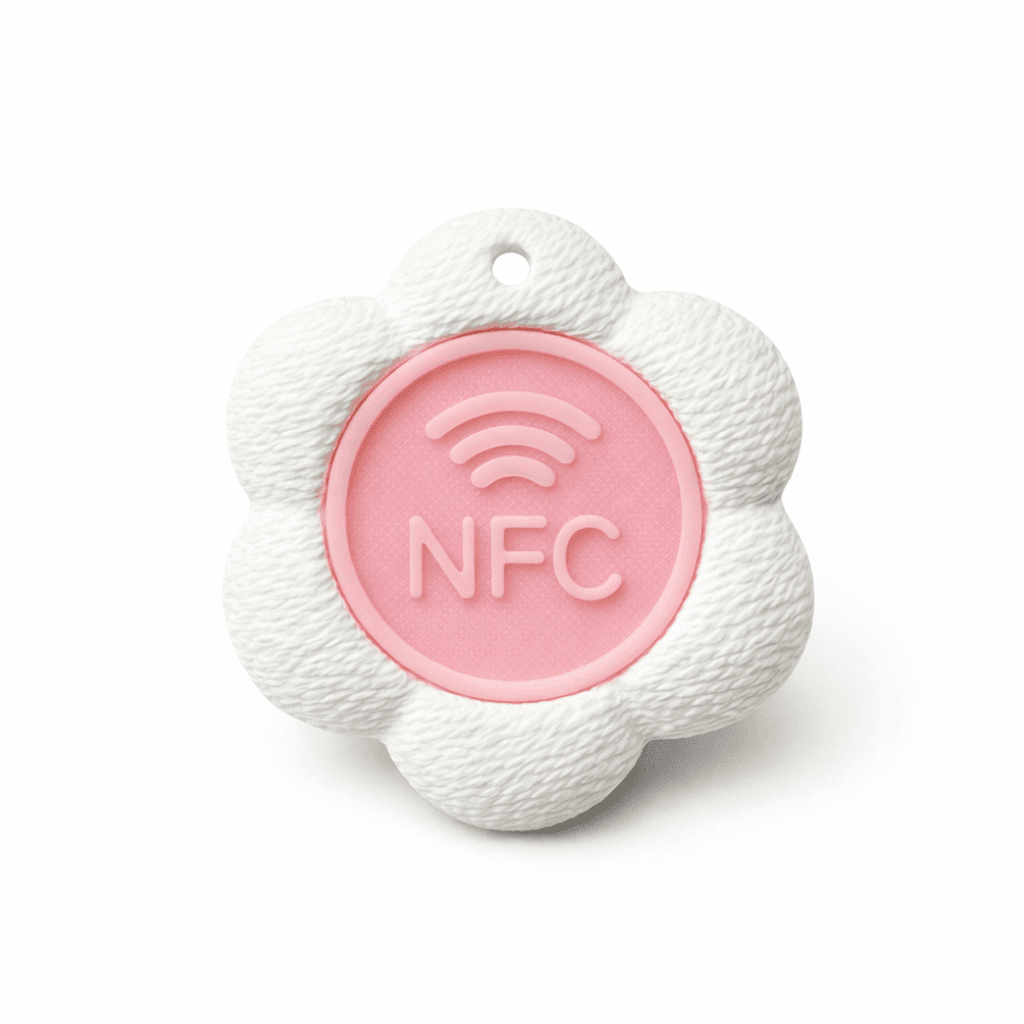
NFC — Near Field Communication — is the same tap-to-pay technology in every modern smartphone. When someone holds their phone near the tag on your dog's collar, a webpage opens instantly with your name, phone number, and any details you've set up. No app download, no account creation, no fumbling with QR codes in bad light.
This matters because most lost dogs are recovered by regular people — neighbors, joggers, kids walking home from school. The faster that person can call you, the faster your dog is home. An NFC tag turns a stranger into a direct line back to you in under three seconds.
There's no battery to die, no network to fail, and no monthly fee. The tag works whether the finder has an iPhone or Android, and it works in areas with zero cell coverage for the initial tap (the page loads once they have signal).
AirTag vs NFC Pet Tag: Side-by-Side Comparison
Here's where the two approaches differ in practice:
Cost: AirTags run about $29 plus a replacement battery each year. Most NFC pet tags, including Bloomtag, are a one-time purchase under $30 with no ongoing costs whatsoever.
Battery life: AirTags last roughly 12 months before needing a CR2032 swap. NFC tags have no battery — they're powered by the phone that taps them, so they never die.
Recovery method: An AirTag helps you search by showing approximate location pings on a map. An NFC tag helps a finder reach you immediately by showing your contact info with one tap.
Works without an app: AirTags need the Find My app on your iPhone. NFC tags work with any smartphone's built-in NFC reader — no app needed, no setup for the finder.
Durability: Both hold up well on a collar. AirTags are IP67 water-resistant. Quality NFC tags are similarly waterproof and built to survive daily wear.
Coverage in rural areas: AirTags struggle in low-population zones where few iPhones pass by. NFC tags work anywhere — they don't depend on a network, just the phone in a finder's hand.
Do You Need Both?
Honestly, the best setup might be both. They solve different parts of the same problem.
An AirTag gives you something to do while you're actively searching — checking the map, driving to the last ping, narrowing down the area. An NFC tag gives the person who actually picks up your dog the fastest possible way to call you.
Think of it this way: the AirTag is your search tool. The NFC tag is your rescue tool. If your budget allows both, use both. If you're picking one, ask yourself which scenario is more likely — that you'll track your dog via Bluetooth pings across town, or that a kind stranger will pick them up and need your number.
For most dog owners, the second scenario is far more common. That's why an NFC tag belongs on every collar as a baseline.
Keep Your Dog's Info Current
Whichever option you choose, the tech only works if your information is up to date. Engraved tags can't be edited after the fact. NFC tags like Bloomtag let you update your contact details anytime from your phone — new number, new address, emergency vet, temporary pet sitter info while you're traveling.
Set a reminder to review your dog's tag info every few months, especially before travel, moves, or holiday weekends when dogs are statistically more likely to bolt.
Your dog doesn't care about the technology on their collar. They just want to get home. Give the next good samaritan the easiest path to make that happen.