You've probably seen the advice: "Just put an AirTag on your dog's collar." It sounds simple enough, and at $29 with no monthly fee, it feels like a no-brainer. But AirTags were designed to find your keys, not your dog — and that distinction matters more than most people realize.
NFC pet tags take a completely different approach. Instead of tracking your dog's location, they give whoever finds your pup a way to contact you instantly. So which option actually keeps your dog safer? Let's break it down.
How an AirTag Works on a Dog
An AirTag doesn't have GPS built in. It relies on Apple's Find My network — a mesh of hundreds of millions of iPhones, iPads, and Macs. When your dog passes near one of these devices, the AirTag pings its location back to you.
In a busy city, that network is dense, and you can get reasonably frequent location updates. In a quiet suburb, a rural trail, or a park at night? Your dog could wander for hours without a single ping. Apple itself has never marketed AirTags as pet trackers, and for good reason.
There are practical concerns too. AirTags are smooth and easy to dislodge from third-party collar holders. If your dog is a rough player or runs through brush, the tag can pop off — and a loose AirTag is a swallowing hazard.
How an NFC Pet Tag Works
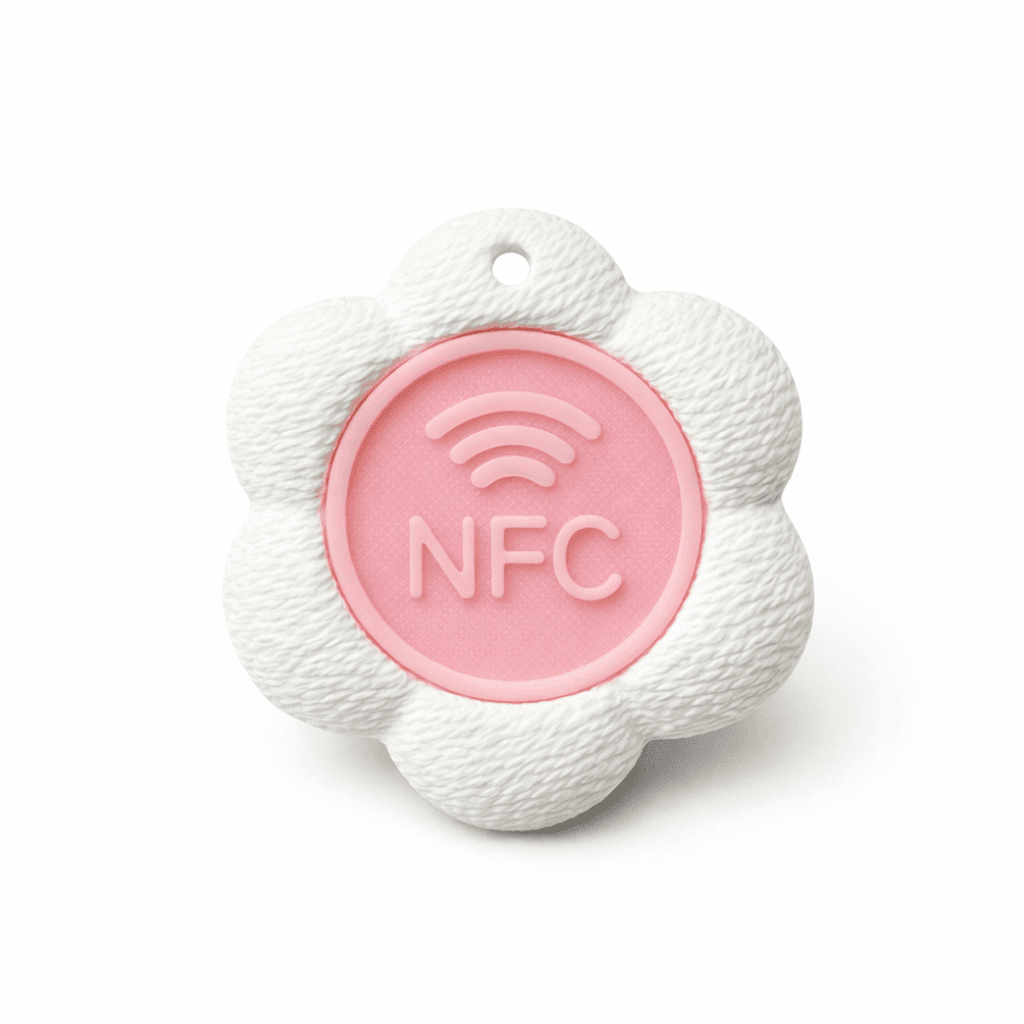
An NFC pet tag stores your contact information on a tiny chip embedded in the tag itself. When someone finds your dog, they hold their smartphone against the tag. A contact page opens instantly in their browser — no app download, no account, no hassle.
This works on virtually every modern smartphone, iPhone or Android. The tag has no battery because it draws power from the phone during the tap. That means there's nothing to charge, nothing to replace, and nothing that degrades over time.
The key insight is that most lost dogs are found by a neighbor, a jogger, or someone walking by — not tracked down via a map. An NFC tag turns that good Samaritan into the fastest path home.
AirTag for Dogs vs NFC Pet Tag: Side-by-Side
Here's where the two approaches differ most:
Cost over time. An AirTag costs $29 upfront, plus a new CR2032 battery roughly once a year. NFC tags like Bloomtag are a one-time purchase with no battery and no subscription — ever.
Recovery method. AirTags help you search for your dog. NFC tags help the person who found your dog reach you. Both are valuable, but the NFC approach works even when the Find My network can't.
Durability. AirTags aren't waterproof at depth and can detach from collar mounts. A purpose-built NFC pet tag is designed to stay put through rain, mud, swimming, and zoomies.
Range limitations. AirTags are only useful where Apple devices are nearby. NFC tags work anywhere a smartphone exists — which, in 2026, is essentially everywhere.
Privacy. AirTags have triggered unwanted-tracking alerts on strangers' phones, which can be confusing in shared spaces like dog parks. NFC tags are passive and only activate when deliberately tapped.
When to Use Both
The smartest dog owners aren't choosing one or the other — they're layering protection. A Bluetooth tracker (AirTag or similar) gives you active search ability if your dog bolts. An NFC tag ensures that anyone who finds your dog can contact you in seconds, even if the tracker loses signal.
Think of it like this: the tracker is your backup plan for searching. The NFC tag is your first line of defense for getting found.
If you only pick one, go with the option that covers the most likely scenario. The majority of lost dogs are recovered because a person found them and reached out to the owner — not because the owner tracked them down on a map.
The Bottom Line
AirTags are clever repurposed tech, but they weren't built for dogs and come with real limitations in range, durability, and safety. NFC pet tags solve the most common recovery scenario — a stranger finds your dog and needs your number, right now.
A tag like Bloomtag makes that moment effortless: one tap, instant contact, no app needed. Pair it with a tracker if you want the full safety net, but don't skip the ID that actually gets your dog home.